
At a glance
Symptoms
- • Gritty, sandy, or cloudy residue left on glasses and plates after a cycle.
- • Standing water pooling in the bottom of the tub at the end of the wash.
- • Foul, swampy, or sour odors emanating from the dishwasher when you open the door.
- • Noticeable decrease in overall cleaning performance and water pressure.
- • Gurgling sounds during the drain cycle.
- • Visible food particles or grease sludge around the bottom spray arm.
Common causes
- • Prevents old food particles from recirculating and baking onto your freshly washed dishes.
- • Protects the delicate drain pump impeller from catastrophic damage caused by hard debris like popcorn kernels, fruit pits, or broken glass.
- • Reduces calcium and limescale buildup, which is especially critical in the Pacific Northwest's notoriously hard water (250-400 ppm).
- • Eliminates breeding grounds for mold, mildew, and odor-causing bacteria in the warm, damp tub.
- • Extends the overall lifespan of the dishwasher's wash motor and circulation system by reducing strain on the pumps.
Safety First — Read Before You Start
- •Always wait for the dishwasher to cool down completely before reaching inside, as the exposed heating element at the bottom of the tub can cause severe burns.
- •Watch out for hidden sharp objects like broken glass, toothpicks, or bone fragments trapped in the filter mesh or sump pit.
- •Never operate the dishwasher with the filter removed; doing so will allow debris straight into the wash pump and can permanently destroy the appliance.
- •Avoid using wire brushes, steel wool, or harsh abrasive pads, which will tear the delicate fine-mesh filter screen and require a costly replacement.
Tools & supplies you'll need
- Soft-bristle brush (an old toothbrush works perfectly)
- Mild degreasing dish soap (e.g., Dawn)
- Distilled white vinegar (approx. $3-$5 per gallon)
- Sponge or microfiber cloth
- Shop vac or turkey baster (optional, for removing standing water)
- Flashlight (to see into the dark sump area)
Step-by-step instructions
Prepare the Dishwasher and Clear the Area
Ensure your wash cycle has finished and the unit has cooled. Open the door and take out the bottom dish rack to clear your workspace. If you find water sitting in the basin, use your turkey baster or shop vac to draw it out so you have a clear view of the filter housing.
Tip: Using a folded towel to kneel on makes the process much more comfortable while working on your kitchen floor.
⚠ Warning: Do not touch the dark metallic heating element ring at the bottom of the tub if the dishwasher was recently run—it retains heat for a long time.
Locate and Unlock the Filter Assembly
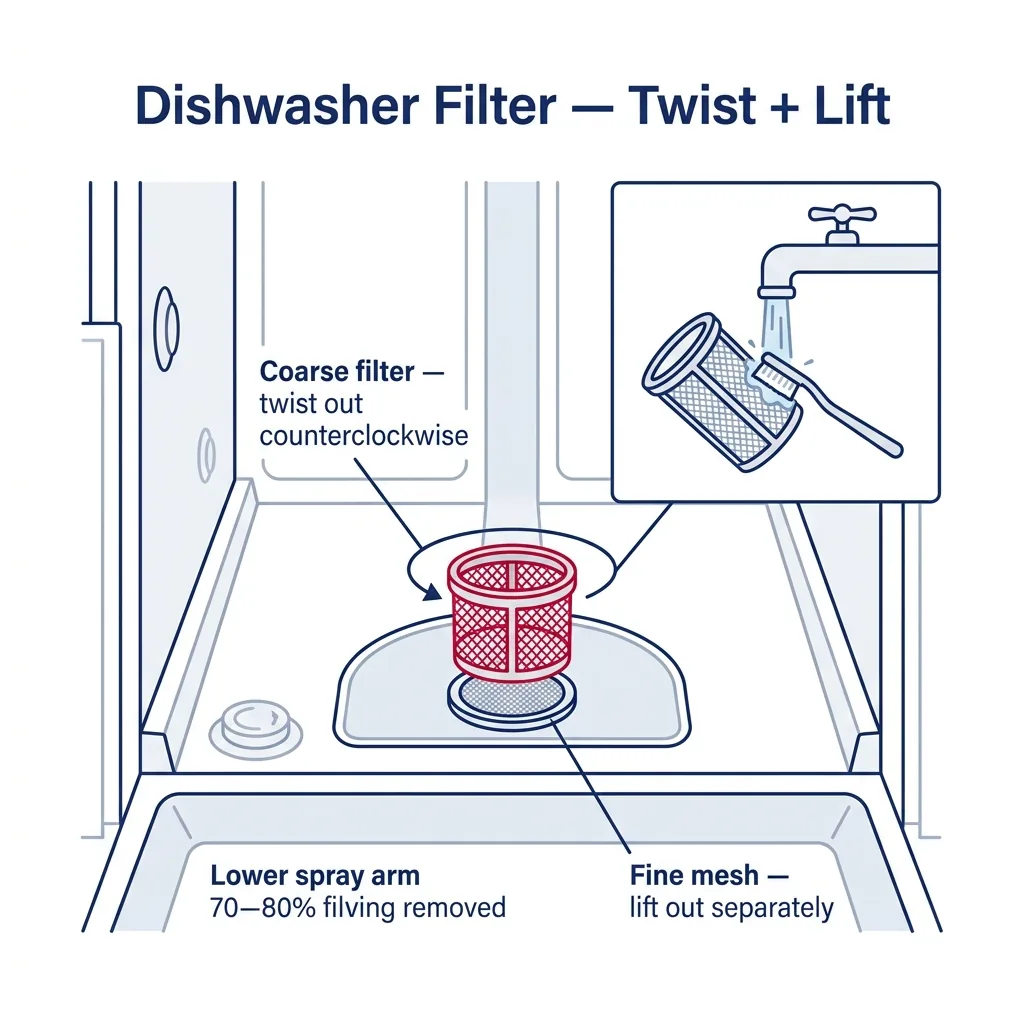
Find the circular filter assembly located on the floor of the tub, usually positioned under the lower spray arm. To remove it, grasp the top of the cylindrical coarse filter and rotate it counter-clockwise about a quarter turn until it pops loose.
Tip: If the filter seems stuck, avoid using tools to force it. Instead, run hot water over the assembly to soften any grease or mineral deposits that might be binding the threads.
Remove the Coarse and Fine Filters
Once the coarse filter is unlocked, pull it upward. You will then see the flat fine-mesh filter plate underneath. Lift this out carefully. Examine both components for any damage or tears; if the mesh is broken, it won't guard your pump properly, and you'll need to source a replacement.
⚠ Warning: Handle the flat fine-mesh filter by its plastic edges. The metal mesh is delicate and can easily crease or puncture if pressed too hard.
Scrub the Filters Under Warm Running Water
In your sink, use warm water and a small amount of degreasing soap with your soft-bristle brush. Scrub both the coarse cylinder and the fine mesh thoroughly to eliminate grease, food residue, and coffee grounds. Rinse them until the water flows freely through the screen.
Tip: For stubborn, greasy sludge that won't scrub off, plug the sink and let the filters soak in hot, soapy water for 10 minutes before brushing.
Tackle Hard Water Scale (The the Pacific Northwest Special)
If you reside in a region with hard water—common in areas like Spokane or the rainy Puget Sound—you may see white, crusty mineral buildup. Soak the filter parts in a bowl of warm white vinegar for about 20 to 30 minutes to dissolve these deposits before a final rinse.
⚠ Warning: Never use bleach to clean your dishwasher filters. Bleach can degrade the plastic components and, if mixed with vinegar or other cleaners, creates toxic fumes.
Clean Out the Sump Pit
Before replacing the filters, use a flashlight to inspect the sump area. Wipe away any remaining grime with a sponge. Check for debris like glass shards or fruit pits that might have fallen into the drain area.
Tip: If you find broken glass in the sump, use a pair of needle-nose pliers or a slice of soft bread pressed against the glass to safely pick up the shards without cutting your fingers.
Reassemble and Lock Securely
Place the fine filter back in the tub, ensuring it lies flat. Reinsert the coarse cylinder and turn it clockwise until it clicks into place. Ensure it is locked securely to prevent it from floating during a wash cycle.
⚠ Warning: Double-check the lock! A loose filter is the leading cause of premature wash motor failure, turning a free maintenance task into a $300-$500 repair.
Brand-specific notes
Some brands have known design quirks worth knowing about before you start.
Bosch & Thermador
Bosch dishwashers are famous for their ultra-quiet operation, which they achieve by completely eliminating the noisy internal hard-food disposer (macerator). Because of this, manual filter cleaning is absolutely mandatory. The filter is a prominent cylinder at the bottom center of the tub. Simply grasp the top handle, twist counter-clockwise, and lift. Bosch filters are highly effective but clog quickly if you don't scrape your plates.
Whirlpool, KitchenAid & Maytag
Many modern models from the Whirlpool family use a 'triple-filter' system. Look for the upper filter assembly that twists out, and carefully lift the lower flat filter. Older models (pre-2015) might have had a self-cleaning macerator, but almost all modern units require manual cleaning. KitchenAid models often have a very fine micro-mesh that is highly susceptible to hard water scaling, making vinegar soaks essential.
GE & GE Profile
GE filters often feature a distinct two-piece design. You usually need to squeeze two plastic tabs on the main filter cylinder to release it, then turn the fine filter counter-clockwise to remove the base plate. Be incredibly gentle with the GE fine mesh; the material is somewhat fragile, and OEM replacement filter kits can run anywhere from $40 to $65.
LG
LG dishwashers generally feature a large rectangular or circular filter plate with a central cylinder. The fine mesh on LG models is notoriously tight to catch tiny particles, which makes it highly susceptible to filming over with grease or hard water scale. If your LG is throwing an 'OE' (drain error) code, a blocked filter is the first thing you should check before assuming the drain pump has failed.
Samsung
On many Samsung models, the filter assembly is located slightly toward the bottom back of the tub rather than dead center. You'll need to twist the central knob and lift the entire unit out. Samsung's micro-mesh is prone to trapping grease, so using very hot water and a strong degreasing dish soap is essential to get the water flowing through the screen again.
What our techs see most often
Roughly 30% of the 'my dishwasher isn't cleaning' calls we get in the San Fernando Valley and King County are just severely clogged filters compounded by our notorious hard water. A quick 10-minute scrub once a month saves homeowners a $150-$200 service call and keeps those pump motors running for years.
When to call a professional
- → If the filter mesh is torn, the plastic housing is warped, or pieces are missing, and you cannot confidently source or install a replacement part yourself.
- → If you have thoroughly cleaned the filter but the dishwasher still refuses to drain standing water, indicating a clogged drain hose, a blocked air gap, or a failed drain pump.
- → If you hear loud grinding, squealing, or rattling noises from the motor area during a cycle, even after removing all debris from the filter sump.
- → If you find metal shavings, heavy machine oil, or rust in the filter area, which points to a failing wash motor bearing or a damaged pump seal.
- → If the filter assembly is permanently jammed and cannot be unlocked by hand without risking breaking the plastic housing or the tub floor.
Related Dishwasher Troubleshooting
These troubleshooting guides cover problems this task can help solve.
Why Your Dishwasher Isn't Cleaning: A PNW Repair Guide
Dishwasher Door Won't Latch or Stays Stuck: Fix Guide
Dishwasher Won't Drain: Clearing Standing Water
Dishwasher Soap Dispenser Won't Open or Release
Tackling Dishwasher Odors: A PNW Homeowner’s Guide
Frequently asked questions
How often should I clean my dishwasher filter?
In the Pacific Northwest areas with hard water (like Portland or Tacoma), we strongly recommend cleaning it once a month. If you pre-rinse your dishes heavily, you might stretch it to every 3-6 months, but monthly cleaning prevents hard water scale buildup and keeps odors at bay.
Can I run the dishwasher without the filter to flush the system out?
Absolutely not. Running the unit without the filter installed will allow large food chunks, glass, and debris to bypass the safeguards and enter the main circulation and drain pumps. This can quickly jam or destroy the pump impellers, leading to a costly $250-$400 repair.
Why does my dishwasher smell like a swamp even after I cleaned the filter?
If the filter is clean, the odor might be coming from a kinked drain hose, a clogged sink air gap (a $15-$30 DIY fix), or food trapped in the rubber door gasket. Wipe down the door seals and run a heavy cycle with a dishwasher cleaning tablet (like Affresh) or a bowl of white vinegar on the top rack.
How much does it cost to replace a damaged dishwasher filter?
If you accidentally tear the mesh or crack the plastic housing, a new OEM (Original Equipment Manufacturer) filter assembly typically costs between $30 and $75, depending on the brand and model. Bosch and KitchenAid filters are usually on the higher end of that price range.
Do all dishwashers have a manual filter that needs cleaning?
Most models manufactured after 2010 do. To meet stricter energy and noise standards, manufacturers removed the loud internal food choppers (macerators) and replaced them with manual wash filters. If your dishwasher is whisper-quiet, it almost certainly has a manual filter you need to clean.
Need a technician in WA or OR?
If the fix above does not work, A-Fix Service repairs dishwashers across Washington and Oregon. $90 diagnostic visit.
Related Repair Guides
Why Your Dishwasher Isn't Cleaning: A PNW Repair Guide
If your plates are coming out with a gritty texture, filmy residue, or food flecks, the culprit is rarely the soap. In the Pacific Northwest, high mineral levels in our water supply frequently lead to scale buildup, clogged spray arm ports, and restricted water flow. These issues account for the vast majority of cleaning complaints. Most of these repairs are straightforward and can be completed in 30 to 90 minutes without needing specialized components.
Dishwasher Won't Drain: Clearing Standing Water
Finding a pool of gray water at the base of your dishwasher is a common headache for homeowners across the Pacific Northwest. Whether you live in rainy Seattle or deal with the hard water of Spokane, the culprit is often simple. Roughly 70% of these issues stem from a blocked filter or a clogged garbage disposal connection—repairs you can handle in under an hour without specialized equipment.
Tackling Dishwasher Odors: A PNW Homeowner’s Guide
Unpleasant smells in your dishwasher usually stem from trapped food debris, a clogged filter, or mineral buildup from our region's water. Follow this guide to diagnose the issue and refresh your machine using common household items.