
At a glance
Symptoms
- • Freezer compartment is above 10°F (-12°C) by thermometer
- • Ice cream is soft; meat thaws on the bottom shelf
- • Compressor runs constantly without cycling off
- • Frost or ice building up on the back wall of the freezer
- • Water pooling at the bottom of the freezer or dripping into the fridge
- • Ice maker producing small or hollow cubes (or none)
- • Chest freezer: lid is hard to lift, suggesting humid air is being pulled in
Common causes
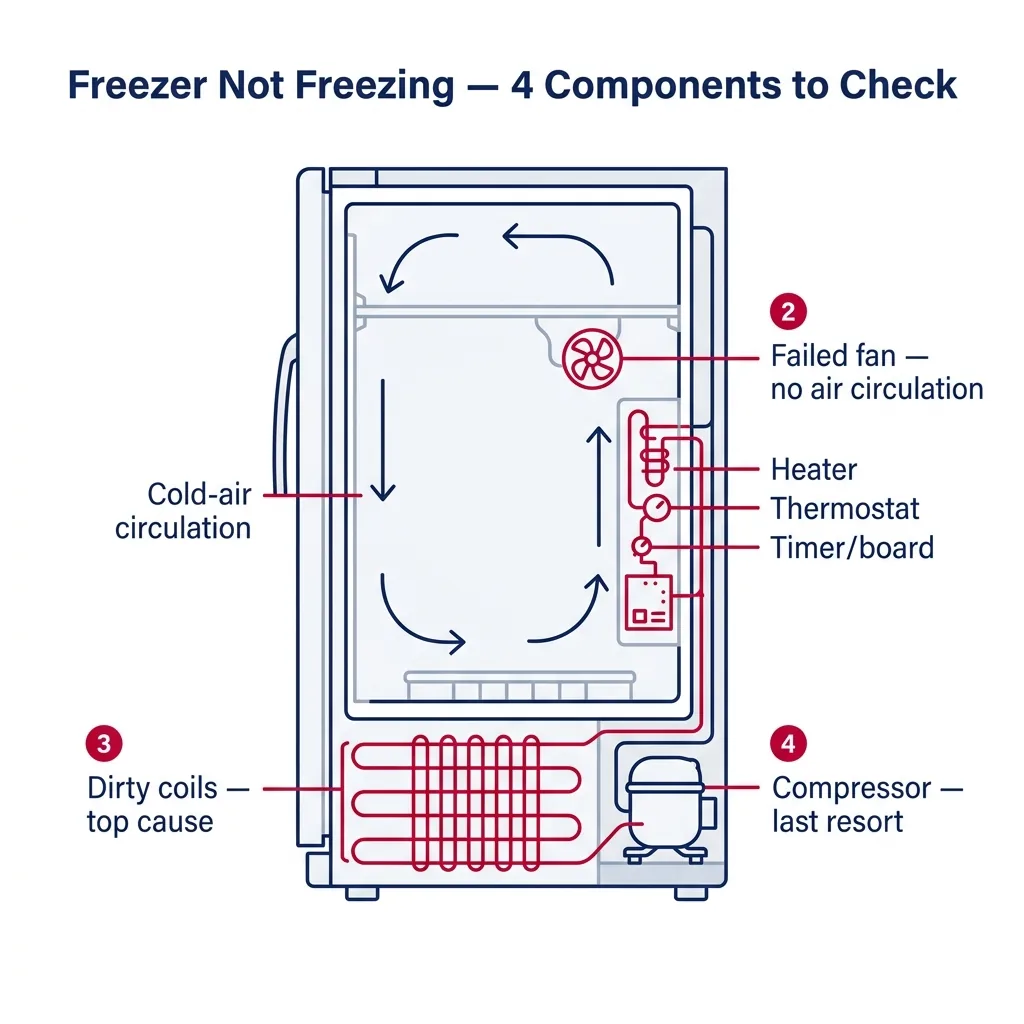
- • Dirty condenser coils restricting heat dissipation (most common single cause)
- • Failed evaporator fan motor — air no longer circulates over the coils
- • Defrost system failure (heater, bi-metal thermostat, or defrost timer/control)
- • Failed start relay or compressor on the sealed system
- • Refrigerant leak — sealed system, requires EPA 608 certified technician
- • Faulty cold-control thermostat
- • Door gasket leaking warm humid air
- • Ice maker stuck in fill cycle, flooding the evaporator with water that freezes the coils solid
Safety First — Read Before You Start
- •Always unplug the freezer before removing any panels or testing electrical components.
- •A start relay capacitor can hold a charge — discharge before testing.
- •If you smell ammonia or hear a hissing sound from the back of the unit, stop immediately. This is a refrigerant leak and requires a licensed EPA 608 technician.
- •If the contents have been above 40°F for more than 4 hours, discard food per USDA guidance — do not attempt to refreeze partially thawed meat or seafood.
- •On chest freezers, the lid hinge has spring tension — do not remove without releasing or supporting the spring.
Tools & supplies you'll need
- Phillips and flat-head screwdrivers
- 1/4-inch nut driver or socket set
- Coil cleaning brush or vacuum with brush attachment
- Multimeter
- Appliance thermometer
- Hair dryer (for thawing iced-over evaporator)
- Towels and a shop vacuum (for melted water)
- Replacement parts as identified
Step-by-step instructions
Verify the temperature and check for easy causes
Place an appliance thermometer in the freezer for at least 4 hours to get an accurate reading. The freezer should hit 0°F (-18°C) or lower. If it stays warmer, verify that the setting hasn't been accidentally adjusted, check that the door is sealing properly (the 'dollar bill test'—the bill should resist when pulled from a closed door), and ensure the unit isn't overcrowded. Proper airflow is vital, especially for chest freezers, which lose efficiency quickly if packed too tightly.
Tip: Maintain at least 1 inch of side clearance and 2 inches at the back for heat dissipation. In hot Pacific Northwest garages, adding an extra inch or two of space is highly beneficial.
Clean the condenser coils
For upright models, you will usually find the coils behind a kick-plate at the bottom or on the rear of the cabinet. Chest freezers often have coils integrated into the unit's skin, which aren't user-serviceable, though you should keep the compressor area dust-free. Unplug the freezer and use a vacuum or brush to remove lint and pet hair. Clogged coils can reduce efficiency by 30% or more, particularly in dusty laundry rooms or garages.
Tip: In coastal PNW areas, salt-air exposure can create a stubborn grime on coils; a gentle scrub with a soft brush and mild soapy water helps remove what a vacuum misses.
Check the evaporator fan (upright freezers only)
Listen for the fan inside the freezer. If it’s silent, press the door switch to ensure it isn't just paused. A quiet fan in a warm freezer usually indicates a motor failure. Unplug the unit, remove the interior rear panel (usually held by 4-8 screws), and inspect the fan. Ensure the blade isn't jammed by ice or food items. If the blade is clear but the motor won't turn, it needs replacement. A new motor typically costs $30-80 and takes about 30 minutes to install.
Tip: If you hear a fan noise that cuts in and out, it is likely failing—replace it now to prevent a total defrost event.
Inspect the evaporator coils and defrost system
Once the panel is removed, examine the evaporator coils. A light, uniform frost is normal. If they are buried in solid white ice, your auto-defrost system is likely malfunctioning. Check the defrost heater (glass tube), the bi-metal defrost thermostat (clipped to the coil), or the timer/control board. Use a hair dryer on a low setting to melt the ice—this can take 20-40 minutes. Test each component for electrical continuity. The bi-metal thermostat is the most frequent and affordable failure point, usually costing $20-25.
Tip: Never use an open flame, heat gun, or sharp tools to remove ice, as the tubing is fragile and a puncture will cause a refrigerant leak.
Test the start relay and compressor (compressor not running)
If the compressor remains silent, listen for a clicking sound occurring every few minutes; this indicates the start relay is struggling to kick the compressor over. Unplug the unit, remove the relay from the compressor side, and give it a shake. If it rattles, it is dead and needs a $15-30 replacement. If a new relay clicks but the compressor still fails to start, the compressor itself is likely failed. Check your manufacturer warranty, as many sealed-system parts are covered for 5-10 years.
Tip: A failing compressor can draw excessive power and trip your breaker; do not repeatedly reset the breaker if it trips.
Check the door gasket and ice-maker overflow
Inspect the door seal for gaps or stiff, brittle areas. A damaged gasket allows warm, humid air inside, which forces the freezer to work harder. Replacement kits are usually $40-80. If your unit has an ice maker, check if the fill tube is dripping into the freezer. A leaky fill valve can cause ice to build up on the evaporator, blocking airflow. If you see ice buildup away from the coils, turn off the ice maker and inspect the valve.
Tip: Coastal humidity in Washington and Oregon can cause gaskets to stiffen faster, often requiring replacement sooner than in drier climates.
Verify the cold-control thermostat
Find the temperature dial or digital control inside the freezer. Switch it to the coldest setting and listen for a click, followed by the compressor starting. If it remains silent at all settings, the thermostat likely needs replacing. Mechanical thermostats run $25-50, while electronic control boards can range from $80-200. On chest freezers, the cold-control is a common failure point located behind a small panel on the upper-front wall.
Tip: Always ensure the unit is plugged in and the power source is active before assuming the thermostat is the problem.
Final test
After repairs, reassemble the unit, plug it in, and set the temperature to mid-range. Place a thermometer inside and keep the door shut for 24 hours. A healthy freezer should reach 0°F (-18°C) and cycle the compressor on and off. If it remains above 10°F after a full day, the issue may be a complex sealed-system fault requiring a professional technician.
Tip: Avoid opening the door during the 24-hour test period to ensure an accurate reading.
Brand-specific notes
Some brands have known design quirks worth knowing about before you start.
Frigidaire
Frigidaire upright freezers (FFFU and FFFH series) commonly have evaporator fan failures around the 6-8 year mark. The fan is identical to the GE part on most models — a generic OEM-spec replacement works fine and saves money over the branded part.
GE
GE garage-ready freezers (FUF series) include a heated cold-control to handle low ambient temperatures. If yours stops freezing during a warm spell, the cold-control may have failed — the unit will read 'too warm' to its own logic and skip cycles.
Whirlpool / KitchenAid
Whirlpool and KitchenAid share the same defrost system on most uprights — a bi-metal defrost thermostat in the $20 range is the most common failure when frost builds up on the back wall. Test the thermostat before replacing the heater.
Samsung
Samsung French-door freezer drawers (RF series) commonly fail with a frozen evaporator fan blocked by ice from a defective drain or ice-maker drip. Listen for a grinding noise from the back of the freezer — that is the fan blade hitting accumulated ice.
LG
LG bottom-freezer and column models can have linear-compressor failures, which LG covers under a 10-year sealed-system warranty on most models. If your LG freezer runs but does not freeze and is under 10 years old, contact LG before paying for any repair — the part and labor are usually covered.
Sub-Zero
Sub-Zero freezer columns and built-ins have dual condenser coils and a complex defrost system. A warm-freezer call on a Sub-Zero is rarely DIY — the kick-grille filter and condenser cleaning is the only end-user maintenance. Anything internal should be a tech with brand training.
What our techs see most often
Our service calls for freezers follow a predictable pattern: 35% are dirty coils (common in garage settings across the PNW), 25% are fan failures, 20% involve defrost system issues, and 10% are electrical issues like start relays. We keep relays and bi-metal thermostats in our vans because they resolve the majority of these common issues quickly.
When to call a professional
- → You smell ammonia, hear hissing, or see oily residue near the compressor — refrigerant leak that requires EPA 608 certification
- → The breaker trips when the unit is plugged in
- → The compressor does not start even after replacing the start relay
- → You have cleaned the coils, replaced the fan, and cleared the defrost ice — and it is still warm after 24 hours
- → The unit is a built-in (Sub-Zero, Thermador, Viking column) — repair complexity and reinstallation justify a tech
- → The freezer is under 10 years old and the compressor has failed (likely covered by manufacturer warranty)
- → You are not comfortable using a multimeter or removing electrical components
Frequently asked questions
My chest freezer is not freezing — is the diagnosis the same as an upright?
Mostly yes, but chest freezers do not have an evaporator fan or auto-defrost — the cooling coils are built into the cabinet walls and you defrost manually. So on a chest freezer, focus on the condenser coils around the compressor at the back, the cold-control thermostat (mounted in front), the door gasket, and the start relay. If the cabinet is iced over inside, you simply need to manually defrost — empty the unit, unplug it, and let it warm up overnight.
How long can food stay safe in a freezer that has lost cooling?
A full freezer keeps food at safe temperature for about 48 hours if the door stays closed; a half-full freezer for 24 hours. Once contents climb above 40°F for more than 2 hours, USDA guidance is to discard meat, poultry, seafood, and dairy. Solidly frozen food (still has ice crystals) can be safely refrozen even if quality suffers.
Why is my freezer running constantly but not getting cold enough?
A freezer that runs but does not reach temperature has a heat-removal problem. The compressor is producing cold but something is preventing the cold from reaching the contents — most commonly dirty condenser coils, a failed evaporator fan, or an iced-over evaporator from a failed defrost system. Less commonly, the sealed system has a slow refrigerant leak that lets the unit cool partially but not fully.
My garage freezer worked fine in summer but not in winter — what is going on?
Most freezers are not rated for ambient temperatures below 50°F. Below that, the cold-control thinks the freezer is already cold enough and skips cycles, allowing the contents to slowly thaw. The fix is a "garage-ready" freezer (rated to roughly 0°F ambient) or a heated thermostat kit on existing models.
How much does freezer repair cost?
Typical DIY parts: start relay $15-30, evaporator fan $30-80, defrost thermostat $20-25, door gasket $40-80. Tech-installed repairs typically run $200-450 for these same components. Sealed-system repairs (compressor, refrigerant leak, dryer filter) start at $600 and on a freezer over 10 years old usually do not justify the cost versus replacement.
Need a technician in WA or OR?
If the fix above does not work, A-Fix Service repairs freezers across Washington and Oregon. $90 diagnostic visit.
Related Repair Guides
Tackling Excessive Freezer Frost: Diagnosis and Repair
While a light dusting of frost is typical, heavy ice accumulation is a sign of trouble. In automatic defrost appliances, thick ice usually indicates a failure in the defrost cycle. For manual-defrost chest units, periodic icing is expected and simply requires a seasonal clear-out every 6-12 months. This guide helps you distinguish between the two and provides a logical repair sequence.
Freezer Door Not Sealing: Resolving Frost and Thermal Loss
A freezer door failing to seal properly permits warm, moisture-rich air to enter, resulting in excessive frost and compromised food safety. We guide you through diagnosing gasket failures, correcting hinge alignment, and restoring a secure seal.
Freezer Running Too Cold: Fixing Freezer Burn and Over-Freezing
When a freezer stays too cold, it wastes electricity and degrades food quality through severe freezer burn. This guide helps you identify and resolve the issue, from simple dial adjustments to replacing faulty temperature sensors.