
At a glance
Symptoms
- • Burner clicks continuously even when the knob is turned to the off position.
- • You smell gas and hear no clicking when trying to light a specific burner.
- • Weak, yellow, or intermittent spark instead of a strong, fast blue spark.
- • One burner won't ignite, but the other burners spark and light perfectly.
- • All burners fail to spark simultaneously (usually points to the spark module).
- • Visible hairline crack on the white ceramic base of the burner electrode.
Common causes
- • Prevents dangerous raw gas buildup in your kitchen from unlit burners.
- • Stops the annoying, continuous clicking sound that can eventually burn out the spark module.
- • Restores the convenience of automatic ignition, avoiding the need for matches or lighters.
- • Resolves electrical shorts caused by liquid spills (like coastal humidity condensation or hard water scale in Spokane) corroding the electrode.
- • Ensures your cooktop operates safely as designed by the manufacturer.
Safety First — Read Before You Start
- •GAS DANGER: Never attempt to remove, modify, or loosen the main gas supply line or internal gas valves. If you smell gas when the stove is off, evacuate and call your gas utility (like Cascade Natural Gas or NW Natural) immediately.
- •ELECTRICAL SHOCK: Gas stoves use 120V electricity to generate the high-voltage spark. Always unplug the stove or flip the circuit breaker before opening the cooktop.
- •SHARP EDGES: The sheet metal beneath the cooktop can be razor-sharp. Wear protective gloves when reaching inside the chassis.
- •FRAGILE CERAMIC: The white ceramic base of the igniter electrode is very brittle. Handle it gently to avoid cracking it during installation.
Tools & supplies you'll need
- Screwdriver set (Phillips and flathead)
- Torx or square-drive bit set (depends on brand)
- Needle-nose pliers
- Multimeter (for testing continuity)
- Small wire brush or fine sandpaper
- Penetrating oil (WD-40 or similar for stuck screws)
- Work gloves and safety glasses
Step-by-step instructions
Disconnect Power and Gas Supply
Safety is the priority. Unplug the stove from the wall. If the appliance is hardwired or the plug is tucked away, trip the dedicated breaker at your home's electrical panel. Locate the gas shut-off valve behind the range and turn it a quarter-turn so the handle sits perpendicular to the line, preventing any gas flow while you work.
⚠ Warning: Never skip disconnecting the power. The spark module generates high voltage that can deliver a severe shock, even if the stove knobs are turned off.
Remove Burner Grates, Caps, and Bases
Clear your workspace by removing the heavy cast-iron grates, burner caps, and heads. To reach the igniter electrode, you typically need to unscrew the burner base from the cooktop surface. Use the correct Torx or Phillips driver. If screws are seized due to mineral deposits from hard water or previous boil-overs, apply a little penetrating oil and wait 15 minutes to avoid stripping the screw heads.
⚠ Warning: Keep a magnetic tray nearby for small screws. They are easy to lose and often unique to specific burner sizes.
Access the Igniter Electrode or Spark Module
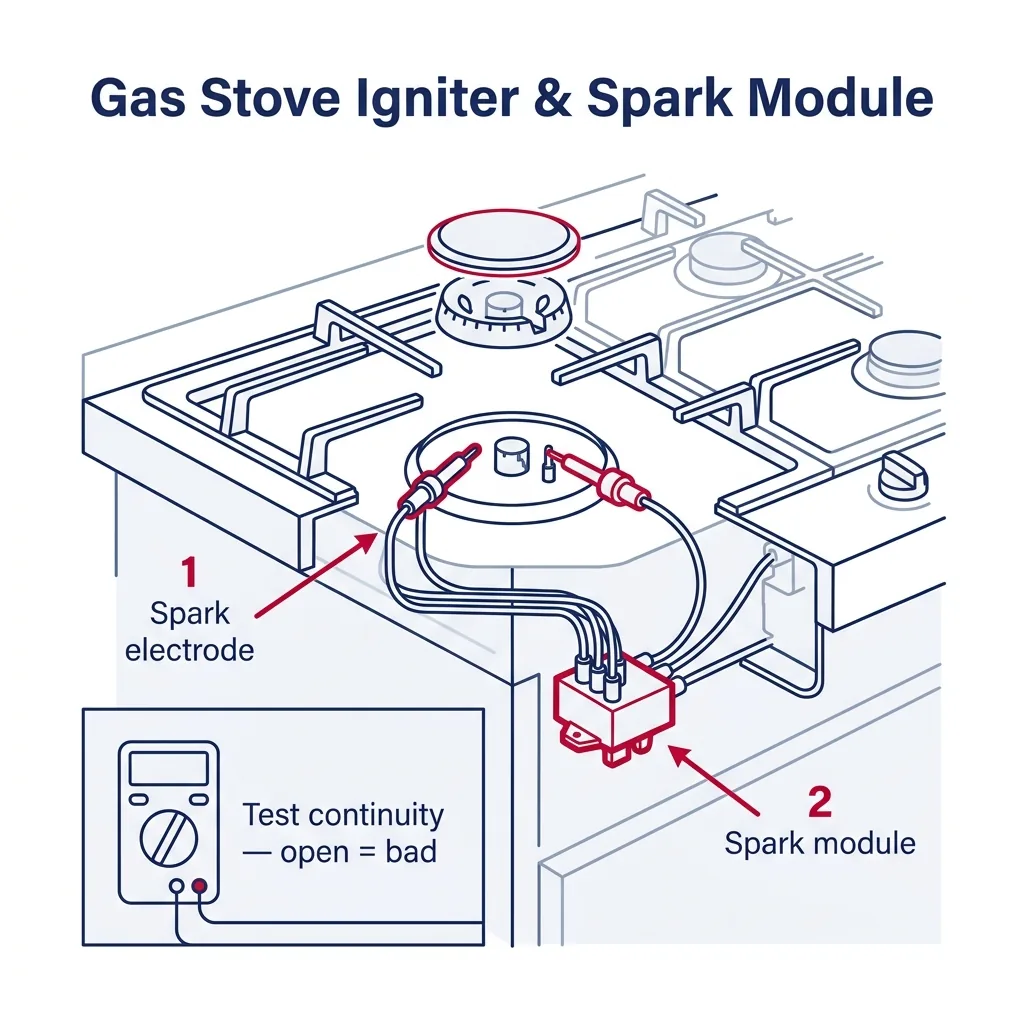
If replacing a single spark electrode (the ceramic piece at the burner), you can usually lift it out once the screws are removed. For the main spark module (the control unit for all burners), you will need to access the rear of the stove. Slide the unit away from the wall and remove the upper back panel to find the plastic box housing the wire connections.
⚠ Warning: Before pulling any wires, snap a photo with your smartphone. This ensures you reconnect the high-voltage leads to the correct terminals.
Remove the Faulty Component
For electrodes: Use needle-nose pliers to carefully detach the wire connector from the bottom of the ceramic igniter. Avoid pulling on the wire itself to prevent damage. For spark modules: Unplug the wire harnesses one by one. Remove the mounting screws or press the plastic tabs securing the module to the frame, then lift it out.
⚠ Warning: If the wire drops into the cooktop chassis during removal, you might need to lift the entire cooktop frame to retrieve it. Use a binder clip to hold the wire in place so it stays accessible.
Install the New Igniter or Module
Attach the wire to the bottom terminal of your new electrode (part costs generally run $15-$30). Carefully seat the ceramic body into the burner base, ensuring it sits flush without tension. If installing a new spark module ($40-$80), snap it into its bracket and reattach the wires using your photo as a guide. Ensure all connections are firm, as loose wires lead to weak or intermittent sparking.
⚠ Warning: Handle the new ceramic electrode with extreme care. Even a tiny hairline crack from a drop can cause the high-voltage spark to arc to the chassis instead of the burner cap.
Reassemble the Cooktop Components
Reinstall the burner bases using the original screws, taking care not to overtighten and strip the aluminum threads. Place the burner heads and caps back in their correct locations. The caps must sit perfectly flat; if tilted, the spark will fail to ground, and the burner will not light.
⚠ Warning: Take a moment to scrub the bottom of the burner caps with a wire brush. Carbon buildup or grease here can interfere with the spark grounding.
Restore Power and Test the Burners
Turn the gas supply valve back on and plug the stove into the outlet. Test each knob by turning it to the 'Lite' position. You should hear a rapid, sharp clicking and see a strong blue spark jump from the electrode to the cap, followed by immediate ignition. Verify every burner to confirm the spark module is working across the entire unit.
Brand-specific notes
Some brands have known design quirks worth knowing about before you start.
Samsung
On the popular NX58 series, the ceramic electrodes are notoriously brittle. If you are aggressive when scrubbing the cooktop, you can easily cause a hairline crack. Once cracked, the spark arcs downward into the base instead of upward to the cap.
LG
For LG slide-in ranges (like the LSG series), the spark module is usually buried deep in the back. You will absolutely need to pull the oven away from the wall and remove the rear access panel. Be careful with the delicate wire harnesses when doing so.
Whirlpool
Many Whirlpool and KitchenAid cooktops use a unified spark wire harness. If one wire shorts out or breaks, you cannot just replace a single wire; you often have to replace the entire multi-wire harness assembly, which runs about $60-$90.
GE
GE Profile cooktops frequently suffer from seized burner base screws due to spill corrosion. Do not force them! Soak them in penetrating oil for at least 15-30 minutes. Stripping a Torx screw here turns a 45-minute DIY job into a massive headache.
Bosch
High-end Bosch gas cooktops have very sensitive grounding requirements. If you install a new igniter and it sparks but the burner won't light, ensure the brass burner cap is perfectly clean and seated. The system relies heavily on that pristine metal-to-metal contact.
What our techs see most often
Across Washington and Oregon, roughly 40% of our 'igniter' calls are simply hard water deposits from boiled-over liquids shorting out the ceramic electrode. If a thorough cleaning with a wire brush and some rubbing alcohol doesn't stop the clicking, swapping the $20 electrode is your next best step before assuming the spark module has failed.
When to call a professional
- → You smell gas even after the stove is turned off and the room is ventilated.
- → The burner base screws are completely stripped or rusted, preventing cooktop removal.
- → You have replaced the igniter and spark module, but the stove still constantly clicks or fails to spark.
- → The repair requires disconnecting, bending, or moving internal aluminum gas tubing.
- → The appliance is a built-in high-end unit (like Sub-Zero/Wolf) where accessing the spark module requires removing the entire heavy unit from custom cabinetry.
Related Stove Troubleshooting
These troubleshooting guides cover problems this task can help solve.
Electric Stove Burner Not Heating: How to Fix
Fixing a Gas Stove That Won't Stop Clicking
Gas Stove Burner Won't Ignite: Causes and Fixes
Broken Glass Cooktop: Assessment and Repair Guidelines
Frequently asked questions
How much does it cost to replace an igniter vs. the spark module?
A single ceramic igniter electrode typically costs $15 to $30. If the main spark module (the control board generating the spark) is dead, expect to pay $50 to $120 for the part. Professional replacement generally ranges from $175 to $250 including labor, parts, and a safety diagnostic.
Why does my stove keep clicking after the burner is lit?
This is usually caused by moisture or grease around the igniter, a cracked ceramic insulator, or a faulty spark ignition switch located on the burner valve behind the knob. The system doesn't realize the flame is lit, so it keeps trying to ignite.
Can I light my gas stove manually if the igniter is broken?
Yes, in most cases, you can use a long multi-purpose lighter. Turn the gas knob to the 'Lite' position, carefully apply the flame to the edge of the burner, and pull your hand back as it catches. However, this is a temporary workaround and you should fix the igniter for safety.
How do I know if the problem is the electrode or the spark module?
If only one burner won't spark, the issue is almost certainly the individual electrode or its specific wire. If none of the burners spark, or if the clicking is weak and erratic across all burners simultaneously, the main spark module or the power supply is usually the culprit.
Are spark modules universal?
No. While they operate on similar high-voltage principles, spark modules are designed with specific mounting brackets, terminal layouts, and varying numbers of burner outputs (e.g., 4-point vs. 5-point modules). Always order the exact OEM part for your specific model number.
Need a technician in WA or OR?
If the fix above does not work, A-Fix Service repairs stoves across Washington and Oregon. $90 diagnostic visit.
Related Repair Guides
Gas Stove Burner Won't Ignite: Causes and Fixes
When you turn the stove knob and hear clicking but see no flame, or hear nothing at all, your gas burner needs attention. We will walk you through diagnosing and fixing the most common ignition failures safely, from simple clogs to electrical faults.
Fixing a Gas Stove That Won't Stop Clicking
If your gas stove is stuck in a clicking loop or fails to ignite, it is usually a minor issue involving moisture or improper parts alignment rather than a major hardware failure. Most of these repairs involve simple maintenance and can be completed in under half an hour. While a failing spark module is a possibility, it is rarely the initial cause; however, chronic exposure to humidity or spills can eventually damage the internal electronics.
How to Clean Gas Stove Burner Caps and Heads
Routine maintenance is key to keeping your burners lighting reliably and maintaining a clean blue flame. We provide a guide on soaking, cleaning, and realigning your burner parts without harming the sensitive gas ports.