
At a glance
Symptoms
- • Burner clicks repeatedly when you turn the knob to ignite, but the flame does not light
- • Multiple burners click at once — even those not in use
- • Clicking continues for several minutes after you turn the burner off
- • Burner lights eventually but only after long delay (5-10 seconds of clicking)
- • Faint smell of unburnt gas while clicking continues
- • Clicking starts on its own with no knob movement (after spills, after cleaning, in humid weather)
- • One specific burner clicks but never lights
Common causes
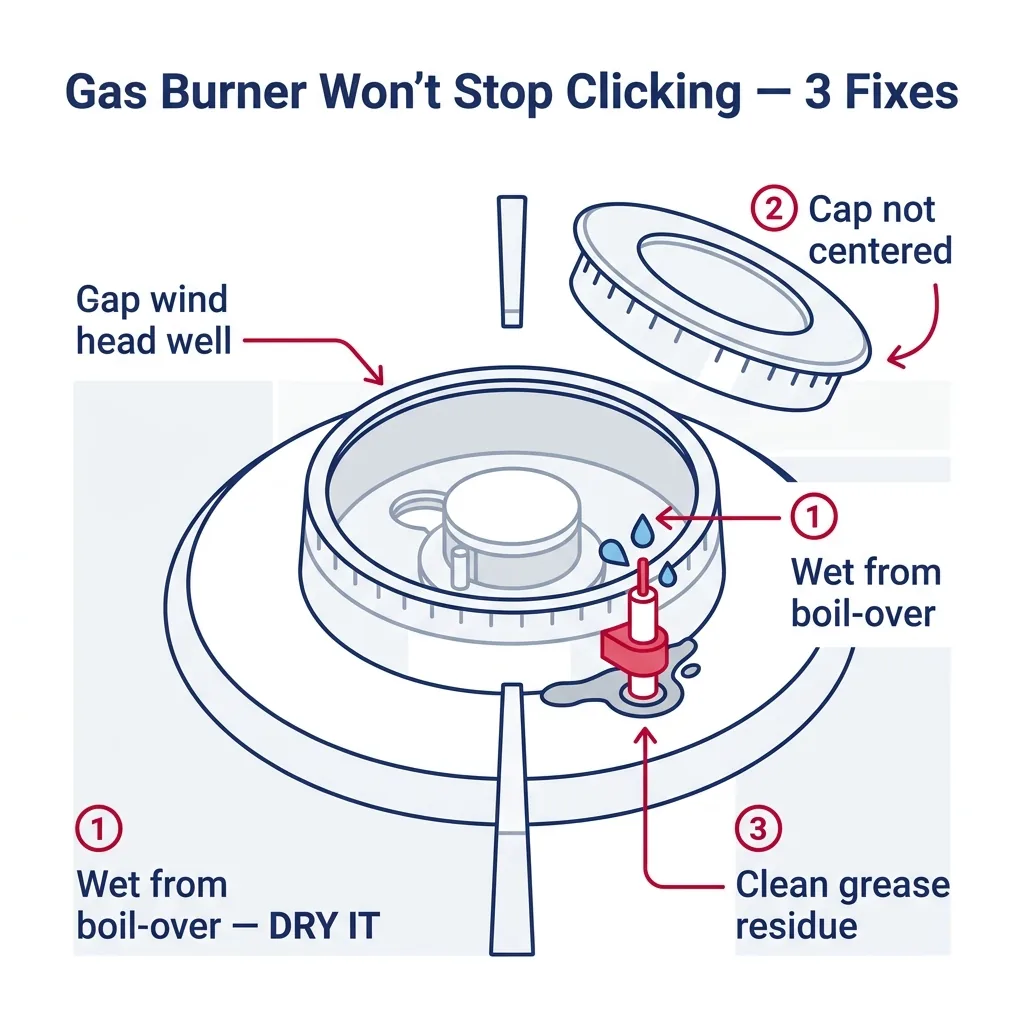
- • Moisture under or around the burner cap (boil-over, drips, or post-cleaning water — most common)
- • Misaligned burner cap not seated correctly on the burner base
- • Dirty or wet ignitor electrode (the small ceramic piece near the burner)
- • Grease or food debris bridging the gap between electrode and burner
- • Faulty spark module (causes constant clicking even with all knobs off)
- • Damaged burner switch (causing one burner to spark constantly)
- • Cracked ceramic insulator on the ignitor — moisture path to the metal body
- • Loose burner head or worn rubber gasket under the cap
Safety First — Read Before You Start
- •If you smell strong gas, do not attempt to troubleshoot — turn off the gas supply at the wall valve, ventilate, leave the home, and call your gas company from outside. See our gas-smell guide.
- •Always turn all burner knobs OFF before working on or near the cooktop.
- •Do not pour water directly onto the burners — moisture is the cause of most clicking issues, not the cure.
- •When removing burner caps and heads, allow them to fully cool. Cast-iron caps stay hot for 30+ minutes after use.
- •If the unit is hardwired electric for the spark module (rather than a plug-in cord), turn off the breaker before any wiring work.
- •Never block or modify the gas orifice. The orifice is sized to your gas type (natural gas vs. propane) and changing it incorrectly is a fire hazard.
Tools & supplies you'll need
- Soft microfiber cloths
- Hair dryer (for drying the burner area)
- Soft toothbrush or small nylon brush
- Mild dish soap
- Toothpick or wooden skewer (cleaning ignitor port)
- Phillips screwdriver
- Replacement ignitor / spark module if needed
Step-by-step instructions
Turn off all burners and listen
First, verify that every burner knob is set to OFF. If the clicking persists despite all knobs being off, you are dealing with a constant-spark issue, likely linked to a stuck spark module or a malfunctioning burner switch. If the clicking only occurs when you attempt to light a specific burner, the problem is localized to that burner assembly. This simple check helps you decide if you are performing basic cleaning or a component replacement.
Tip: For cases of constant sparking, you can silence the noise by unplugging the range or flipping the circuit breaker. This does not affect the gas flow, but it safely disables the spark generator while you investigate.
Dry everything thoroughly
If the clicking started after a spill, a deep clean, or during damp Pacific Northwest weather, moisture is the culprit in roughly 80% of cases. Remove the burner cap and head. Wipe down the area with a microfiber cloth, then use a hair dryer on a low setting for about 5-10 minutes to eliminate hidden moisture in the ignitor and burner base. Reassemble and test; often, this is all it takes to resolve the issue.
Tip: To prevent future clicking, use a hair dryer for a few minutes on the burner area after every deep cleaning session.
Reseat the burner cap and head correctly
Most modern stoves use a three-part assembly: the burner base, the burner head, and the burner cap. These pieces must be perfectly aligned. If the cap is slightly off-center, the spark will fail to ignite the gas. Check for alignment notches or tabs that lock the cap into the head. The assembly should sit completely flat with no wobble.
Tip: If the cap wobbles after being seated, the burner head or base may be warped due to heat or heavy cookware. Do not attempt to bend it back; a warped part requires replacement.
Clean the ignitor electrode
The ignitor is the small ceramic-and-metal rod positioned beside the burner head. Its tip should be clean and located about 1/8 inch from the burner head. Gently scrub away grease or debris using a soft toothbrush. For food stuck in the gap, use a wooden toothpick. Avoid metal tools, as they can damage the electrode or alter the spark gap. Once clean, use a hair dryer to ensure it is completely dry.
Tip: A dirty ignitor produces a weak or intermittent spark. Periodic cleaning, especially during the rainy season, helps maintain consistent ignition.
Test by turning on the burner
Once dry and aligned, turn the knob to ignite. You should hear a few clicks followed by a flame. If it lights, the issue is resolved. If it clicks repeatedly without lighting, check for a gas smell. If there is no smell, the safety system is likely cutting the gas because it detects no flame. If you smell gas but no ignition, the spark may be weak or misplaced—re-check the gap. Never let a burner click for more than 5-10 seconds while gas is flowing.
Tip: If the burner fails to light, turn the knob off, ventilate the kitchen for 5 minutes, and try again later.
Diagnose constant-clicking (clicks with all knobs off)
Constant clicking indicates a switch is falsely signaling the spark module. This points to either a faulty burner switch or a failed spark module. To isolate, remove the burner caps and heads. If the clicking stops when a specific switch is manipulated, that switch is the problem. If it clicks regardless of the knob positions, the spark module is likely defective. Switches generally cost $30-60, while modules run $40-100.
Tip: Switches are usually reached by removing the front control panel, while spark modules are typically found inside the cabinet near the cooktop.
Replace the ignitor or spark module if needed
If the ignitor is cracked or has a damaged ceramic insulator, replace it (usually $15-25). It is secured by screws and connects to the module via a single wire. Replacing the spark module involves turning off the power, documenting the wiring layout (typically 8-10 wires), swapping the unit, and reconnecting. If the clicking returns after a few weeks, check for moisture infiltration caused by a faulty ignitor.
Tip: Take a photo of the wiring before disconnecting anything to ensure a correct reinstallation.
Brand-specific notes
Some brands have known design quirks worth knowing about before you start.
GE
GE Profile and Cafe gas ranges (PGB, PGS, CGS series) use a single spark module mounted under the cooktop. The module is the most common eventual failure on these — when one fails, all burners typically click together for a moment when any knob is turned. Replacement is a 10-wire swap with the module clearly labeled.
Whirlpool
Whirlpool gas ranges (WFG, WCG series) often have ignitors that crack at the ceramic insulator after years of grease exposure. A cracked insulator is the second-most-common cause of intermittent clicking on Whirlpool — visible as a hairline ring around the ceramic. Replace the ignitor itself; the module is usually fine.
Samsung
Samsung gas cooktops and ranges (NX, NA series) tend to have constant-clicking issues that trace to the burner valve / switch assembly. Samsung uses a slightly different switch design than other brands and a damaged switch may not just cause constant clicking but also gas-flow issues. Get the brand-specific switch — generic substitutes do not fit reliably.
LG
LG gas ranges (LRG and LSG series) commonly have ignitor issues from boil-overs in their wide oval grates. The ignitor electrodes are mounted close to the burner head and accumulate splatter quickly. A monthly cleaning routine on these prevents most clicking complaints.
Frigidaire
Frigidaire and Electrolux gas ranges (FCRG, FGGF, FFGF series) frequently have failures of the burner cap alignment when the caps are placed off-tab during cleaning. If a customer cleans the cooktop and clicking starts immediately, suspect cap alignment first.
Bosch
Bosch gas cooktops (NGM and 800 series) use higher-end sealed burners with tighter ignitor gaps. Moisture has a more noticeable effect on these — drying with a hair dryer is genuinely required after any wet cleaning, not optional. The ignitor part is brand-specific and only available through Bosch parts channels.
What our techs see most often
Calls about constant clicking are usually split 70/30. About 70% of the time, it is just moisture from a recent cleaning, which we fix with a hair dryer in 10 minutes. The remaining 30% usually involve a bad burner switch or a failing spark module. We carry common replacement parts for GE, Whirlpool, and Samsung units on our service vans. If you are dealing with constant noise, just unplug the stove to stop the clicking while we head your way.
When to call a professional
- → You smell strong, persistent gas — call the gas company first, then a licensed gas appliance tech
- → Clicking persists after drying, reseating caps, cleaning ignitors, and replacing the suspect ignitor
- → You replaced the spark module and clicking continues — the issue is wiring or grounding
- → The unit is a high-end commercial-style range (Wolf, Viking, Thermador) where DIY work may void the warranty
- → You see scorched or melted wiring around the spark module
- → A burner is producing yellow flames or sooting (separate issue but often discovered while diagnosing clicking)
- → You are not comfortable working with the front panel and switch wiring on the cooktop
Stove Maintenance & Replacement Tasks
Step-by-step guides for individual maintenance jobs related to this appliance.
Frequently asked questions
Why does my gas stove keep clicking even when it is off?
Constant clicking with all knobs off means the spark module is being signaled to fire even when no burner has been activated. Two parts can cause this: a damaged burner switch (one knob's internal contacts are shorted) or a failed spark module. Test by removing each burner cap and head one at a time; if rotating a specific knob silences the click, that switch is the culprit. If nothing changes regardless of knob position, replace the spark module.
Is it safe to use the stove if it keeps clicking?
Brief clicking (a few seconds during ignition) is normal and safe. Continuous clicking that won't stop is annoying but not directly dangerous — the gas is only released when a knob is turned, and the constant spark is harmless to the appliance. However, if the clicking is paired with a gas smell or a burner that won't light, turn off the gas at the supply valve and ventilate. Do not let unburned gas accumulate.
Why does my burner click but not light?
Three common reasons: moisture or food debris on the ignitor, the burner cap is misaligned and sparks miss the gas flow, or the spark itself is too weak from a dirty or cracked ignitor. Try drying the area, removing and reseating the burner cap with the alignment tab in its slot, and brushing the ignitor clean. Roughly 80% of these cases resolve with cleaning and drying alone.
How long does an ignitor electrode last?
Ignitor electrodes typically last 10-15 years on average, longer if the cooktop is kept clean and dry. Premature failures (under 5 years) are usually due to repeated boil-overs or aggressive cleaning sprays attacking the ceramic. Replacing one is a $15-25 part and a 5-10 minute job.
My stove worked fine, then I cleaned it and now it clicks constantly. What happened?
Cleaning sprays and water seep under the burner caps and onto the ignitors. The moisture either prevents a clean spark or shorts the ignitor signal so the spark module fires constantly. Remove the burner caps and heads, dry everything thoroughly (a hair dryer is fastest), and reassemble. Going forward, dry the burner area immediately after wet cleaning and never spray cleaner directly into the ignitor area.
Need a technician in WA or OR?
If the fix above does not work, A-Fix Service repairs stoves across Washington and Oregon. $90 diagnostic visit.
Related Repair Guides
Electric Stove Burner Not Heating: How to Fix
If an electric burner on your range stops heating, it is often a straightforward fix. Typical culprits include a burnt-out heating element, a faulty infinite switch, a damaged burner receptacle, or loose terminal connections. While the diagnostic approach varies slightly between traditional coil stoves and modern smooth-top radiant ranges, most homeowners can complete the repair for under $50 in parts within an hour.
How to Clean Gas Stove Burner Caps and Heads
Routine maintenance is key to keeping your burners lighting reliably and maintaining a clean blue flame. We provide a guide on soaking, cleaning, and realigning your burner parts without harming the sensitive gas ports.
Gas Stove Burner Won't Ignite: Causes and Fixes
When you turn the stove knob and hear clicking but see no flame, or hear nothing at all, your gas burner needs attention. We will walk you through diagnosing and fixing the most common ignition failures safely, from simple clogs to electrical faults.