
At a glance
Symptoms
- • Washer takes an unusually long time to drain
- • Clothes are soaking wet at the end of the spin cycle
- • Washer displays OE, 5E, or Nd error codes
- • Smelly, musty, or mildew odors emanating from the drum
- • Unusual rattling, clicking, or grinding noises during the drain cycle
- • Washer completely stops mid-cycle full of water
Common causes
- • Prevents catastrophic drain pump motor failure (saving you a $250-$400 professional repair)
- • Stops mildew and mold growth caused by sitting, stagnant water in the pump housing
- • Ensures the washer can reach maximum spin speeds (washers will abort high-speed spins if the water level pressure switch detects standing water)
- • Removes abrasive obstructions like beach sand (very common in the Pacific Northwest), pet hair, and forgotten pocket items
- • Clears hard water calcium buildup from the impeller blades, ensuring efficient water flow
Safety First — Read Before You Start
- •Always unplug the washer from the wall outlet before opening any access panels to prevent electric shock.
- •If you recently ran a hot water or sanitize cycle, wait at least 1 to 2 hours before opening the filter. The residual water inside can be scalding hot.
- •Be prepared for 1 to 2 cups of residual water to spill out. If the washer is full of water and won't drain at all, you may have gallons of water waiting behind that cap.
Tools & supplies you'll need
- Shallow baking dish or pie pan
- Large old bath towels
- Needle-nose pliers (for stubborn debris)
- Old toothbrush
- Flashlight
- White vinegar (optional, for hard water scale)
Step-by-step instructions
Prep the Area and Locate the Access Door
Begin by disconnecting the power. Find the small access panel for the drain pump, typically located on the bottom front corner of your washer. Place a thick towel underneath this area. Since some water will inevitably escape when the filter is removed, this step protects your flooring, which is especially critical for those living in upper-level apartments or homes with finished basements.
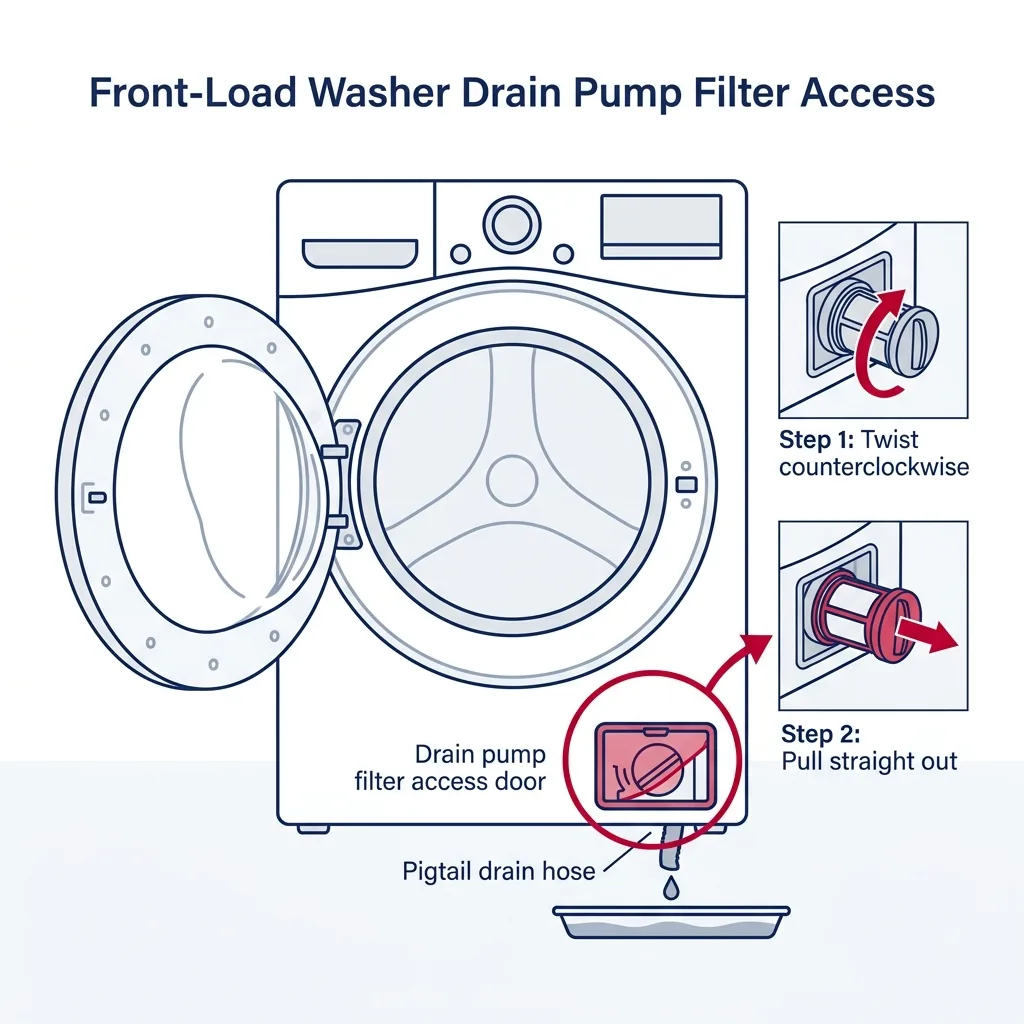
Tip: If your machine is in a tight space or sits in a drip tray, a flat baking sheet works better than a bowl to catch the excess water.
Drain the Residual Water
Open the access door to reveal the filter knob and a small rubber drain hose. Do not remove the large filter yet. Instead, unclip the small hose, point it into your shallow pan, and remove the plug. Allow the water to drain out completely. If your pan fills up, plug the hose, empty the water, and repeat until the flow stops. This prevents a sudden flood when you remove the main filter.
Tip: If the water keeps flowing and won't stop, the main tub is likely still full. Re-plug the hose and manually bail the water out of the drum.
Unscrew and Remove the Filter Cap
Once the auxiliary hose is drained, secure the plug and clip it back. Grip the large filter knob firmly and rotate it counter-clockwise. It might be resistant, particularly if you have hard water (common in areas like Spokane or Portland). Turn slowly; as the seal breaks, a small amount of water may leak out. Keep unscrewing until the filter is free from the housing.
Tip: Do not use tools to force a stuck cap, as you could crack the housing. Apply a little white vinegar around the threads to help loosen mineral deposits.
Clean the Filter and Inspect the Housing
Clean the filter in your sink by removing all lint, hair, coins, or pins. Use a toothbrush and soap to scrub away any slime or mineral buildup. Use a flashlight to inspect the empty housing. You will see the pump impeller blades at the back. Use your fingers or needle-nose pliers to remove any debris wrapped around them. Gently spin the impeller; it should move with a slight, magnetic, choppy motion.
Tip: Be careful when reaching into the cavity, as sharp debris like metal screws or broken glass is often caught inside.
Reinstall the Filter and Test for Leaks
Insert the clean filter back into the housing, ensuring it is properly aligned. Tighten it by turning it clockwise until it is hand-tight. Avoid cross-threading; if it feels misaligned, back it out and start over. Once secure, close the door, plug the machine in, and run a 'Rinse & Spin' cycle. Check the area for any signs of moisture to ensure a watertight seal.
Tip: Ensure the filter is snug. Even a minor gap can cause a significant leak during the next load of laundry.
Brand-specific notes
Some brands have known design quirks worth knowing about before you start.
LG
LG units usually have a fold-down door on the bottom left. Be gentle when removing the auxiliary hose plug to avoid tearing the rubber.
Samsung
On Samsung VRT and newer models, the filter is behind a push-to-release door on the bottom right. A clogged filter here often triggers '5E' or 'Nd' error codes.
Whirlpool / Maytag
Some older Whirlpool Duet or Maytag Maxima models require removing the entire lower kick panel using three Torx (T-20) or 1/4-inch hex screws.
Bosch
Bosch compact 24-inch models feature a circular cover on the bottom right. Because space is very limited, ensure you have a flat tray ready to catch water.
GE
GE front-loaders often have a swing door on the bottom right. Their housings tend to hold more water, so have extra towels ready.
What our techs see most often
Across the rainy Pacific Northwest, we frequently find filters clogged with beach sand and debris. Taking a few minutes to clean this yourself prevents a costly service call for a simple maintenance issue.
When to call a professional
- → The filter cap is completely seized and won't turn (forcing it will break the pump housing, requiring a full replacement).
- → You've thoroughly cleaned the filter and impeller, but the washer still won't drain or makes a loud humming noise (likely a dead pump motor).
- → The small rubber auxiliary drain hose is cracked, brittle, or leaking water.
- → You find damaged or broken plastic impeller blades inside the pump housing.
- → The washer is stacked in a tight closet and you cannot safely access the bottom front panel without moving the heavy units.
Related Washer Troubleshooting
These troubleshooting guides cover problems this task can help solve.
Decoding Washing Machine Error Codes: A Quick Guide for LG, Samsung, Whirlpool, and GE
Why Your Washing Machine Shakes and Vibrates: Troubleshooting and Solutions
Washing Machine Leaking from Bottom: Locate and Resolve the Issue
Washing Machine Won't Spin: Troubleshooting Tips
Washing Machine Odors: A Guide to Clearing Mold and Mildew
Frequently asked questions
How often should I clean my washer drain pump filter?
General maintenance suggests every 2 to 3 months. If you have pets, wash heavily soiled work items, or live in a sandy area, check it monthly.
I can't get the filter cap to turn. What do I do?
Avoid using tools to force it. Hard water buildup is common in our region; try using a vinegar-soaked cloth to break down the minerals. If it remains stuck, contact us to avoid cracking the pump housing.
Water keeps coming out when I open the little hose. Is this normal?
A small amount of residual water is expected. If it continues to flow, your main drum is likely still full, suggesting a deeper clog or a leaking inlet valve.
Why does my washer smell like rotten eggs even after I cleaned the filter?
Odors often originate from the rubber door boot gasket. Wipe it down well and run a cleaning cycle with bleach or an Affresh tablet. If the mold is deep in the gasket, it may need replacement.
Need a technician in WA or OR?
If the fix above does not work, A-Fix Service repairs washers across Washington and Oregon. $90 diagnostic visit.
Related Repair Guides
Washing Machine Won't Drain: Troubleshooting Guide
A washer that fills but fails to empty is a common issue we encounter across the Pacific Northwest. About 70% of these service calls are solved by removing a blockage from the pump filter, unkinking a hose, or clearing an object from the impeller. Most homeowners can fix this in under an hour using basic tools.
Washing Machine Odors: A Guide to Clearing Mold and Mildew
If your washer has a swampy, musty smell, it is likely due to mold, mildew, or a buildup of detergent-based biofilm. This guide will walk you through the process of deep-cleaning the gasket, clearing the drain pump filter, and performing a sanitizing tub flush to permanently remove odors.
Washing Machine Won't Spin: Troubleshooting Tips
A laundry machine that fills and agitates but fails to reach the spin phase is a common issue for homeowners across the Pacific Northwest, from the humid coast of Bellingham to the dry, cold winters in Bend. Frequently, the issue is as simple as an unbalanced load, a faulty door lock, a snapped belt, or a worn motor coupling—most of which can be resolved in under an hour.