
At a glance
Symptoms
- • Drum agitates or tumbles but never enters the spin phase
- • Cycle finishes but clothes come out soaking wet
- • You hear the motor humming but the drum does not turn
- • Front-load door will not lock or shows a "dL" / door error
- • Washer pauses indefinitely before spin and may show a drain or balance error
Common causes
- • Unbalanced load triggering the auto-balance sensor and stalling the spin
- • Failed lid switch (top-load) or door lock assembly (front-load) preventing spin start
- • Broken or stretched drive belt slipping off the motor pulley
- • Worn motor coupling on direct-drive top-load washers (a $15 plastic part)
- • Clogged drain pump — most washers refuse to spin until water is drained
- • Faulty motor control board (MCU) or main control board not signaling the motor
Safety First — Read Before You Start
- •ALWAYS unplug the washer before removing any panel, accessing the pump, or testing components.
- •Never bypass the lid switch or door lock — these prevent the drum from spinning at 800-1200 RPM with the lid open and can cause serious injury.
- •The motor control board carries high-voltage DC capacitors that can hold a charge for several minutes after unplugging. Do not probe live boards.
- •Front-load washers are heavy (180-250 lb) and unstable when tipped. Always work with a partner or use proper appliance dollies.
- •Turn off both hot and cold water supply valves before disconnecting any hoses to avoid flooding.
Tools & supplies you'll need
- Phillips and flat-head screwdrivers
- 1/4-inch and 5/16-inch nut drivers or socket set
- Multimeter (for switch and motor continuity testing)
- Pliers and channel-lock pliers
- Flashlight
- Shallow pan and towels for residual water
- Putty knife or trim tool (for prying front-load top panels and clips)
Step-by-step instructions
Redistribute the load and run a spin-only cycle
Before grabbing your tools, check the contents of the drum. A heavy, water-logged blanket or bath mat concentrated on one side will trip the auto-balance sensor found in modern machines. Remove the items, shake them out to untangle, and distribute them evenly around the tub. Close everything up and select a "Spin Only" or "Drain & Spin" cycle. If it spins, your issue was simply an uneven load.
Tip: Front-load units are particularly sensitive to weight distribution; even two heavy towels can cause an LG or Samsung model to abort the cycle.
Confirm the washer drained completely
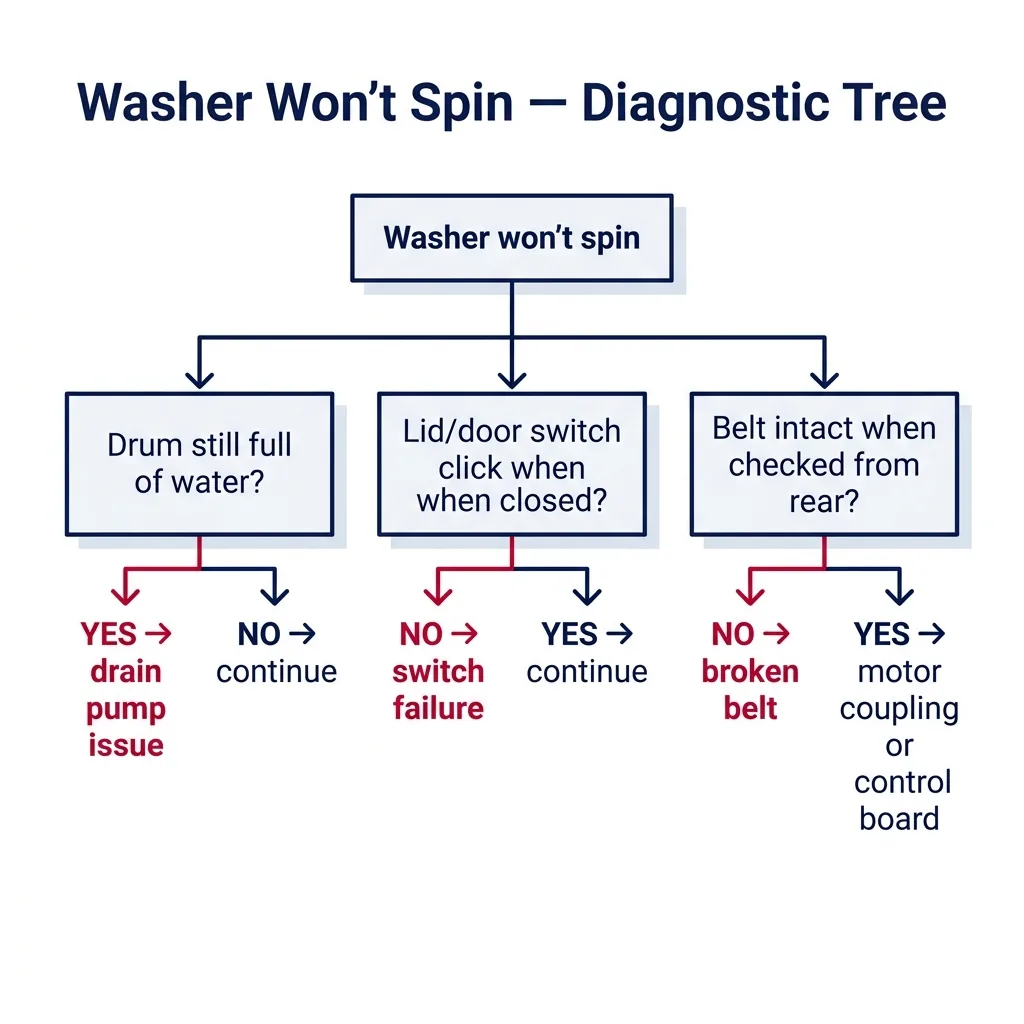
Check the drum for standing water. If water remains, the machine won't spin for safety reasons. Locate the drain pump filter—found behind a small door on the front of most front-loaders—and have a pan ready. Carefully unscrew the filter to drain the remaining water and clear out debris like coins, lint, or small socks. Once clear, tighten it back up and try a drain cycle.
Tip: If the filter is clear but water remains, the pump impeller might be blocked or damaged.
Test the lid switch (top-load) or door lock (front-load)
For top-loaders, look for the small plastic switch on the cabinet rim that the lid depresses. Use a multimeter on the terminals to check for continuity while pressing the switch. If it fails, the switch needs replacing. On front-loaders, check the door lock assembly near the latch. If the machine doesn't register that the door is locked, the solenoid or wiring may be faulty.
Tip: Never tape or wedge a switch shut to bypass it; this is a safety hazard and is not a professional repair.
Inspect the drive belt (belt-drive models)
Unplug the unit and remove the access panel. Inspect the rubber belt connecting the motor to the drive pulley. If it's lying at the bottom of the cabinet, it's snapped. If it's still on but appears cracked, glazed, or loose, it likely needs replacement. Use the OEM part number on the old belt to source a new one.
Tip: Take a photo of the belt routing before you remove it so you can replicate the path during installation.
Check the motor coupling (direct-drive top-loaders)
On classic direct-drive top-loaders, a three-piece coupling connects the motor to the transmission. If you hear the motor whirring but the drum stays still, this part has likely sheared due to overloading. Gain access to the motor, remove the clips, and inspect the coupling for broken plastic or shredded rubber. Replace with a new kit if damaged.
Tip: The motor is heavy, so be prepared for its weight when removing it.
Verify the motor and motor control board
If mechanical parts look fine, test the motor windings with a multimeter for continuity. Check your specific model's tech sheet—often hidden behind the kick-plate—for the correct resistance values. On front-loaders, inspect the Motor Control Board (MCU) for any signs of burning or a burnt odor, which indicates a failed board.
Tip: Always consult the manufacturer's tech sheet for accurate resistance numbers rather than guessing.
Run a calibration cycle and final test
After replacing components, run the machine's calibration or test mode to reset the internal balance sensors and verify the drum weight. Once calibrated, test the machine with a small, balanced load of laundry and listen for any unusual sounds as the speed ramps up.
Tip: Search your specific model number online to find the exact key sequence required to enter test mode.
Brand-specific notes
Some brands have known design quirks worth knowing about before you start.
Samsung
Samsung VRT front-loaders may show 'tE' or 'uE' errors due to brake assembly issues. This often requires professional intervention.
LG
LG WashTower models may display 'LE' errors if the hall sensor fails. Note that the direct-drive motor often carries a 10-year warranty.
Whirlpool / Kenmore (Cabrio top-load)
The shifter assembly often fails on these units, throwing 'F7-E1' or 'F7-E5' codes. If the drum spins manually but the motor won't engage, the shifter is likely the culprit.
Maytag
Older MVWC and MVWB models frequently experience lid switch contact failure after several years of use.
GE
For GFW/GTW series, check the door strike for wear. A bent strike can prevent the latch from triggering correctly.
What our techs see most often
Our dispatch logs for Washington and Oregon indicate that about 30% of 'no spin' calls are caused by simple drain pump obstructions. Another 25% involve motor coupling failures on direct-drive models, followed by door/lid switch issues. If you hear the motor running but see no movement, we usually arrive prepared to swap a pump or a coupling.
When to call a professional
- → You hear grinding or metal-on-metal scraping, which suggests a bearing failure.
- → Motor windings test as open or shorted on an older machine.
- → You see obvious electrical damage like melted connectors or burnt boards.
- → The washer is leaking from underneath during spin attempts.
- → The machine is a stacked unit like a WashTower that requires professional unstacking for access.
- → You have replaced the likely parts but the issue persists.
Washer Maintenance & Replacement Tasks
Step-by-step guides for individual maintenance jobs related to this appliance.
Maintaining Your Washing Machine Drain Pump Filter
Removing Mold from Your Front-Load Washer Gasket
How to Descale a Washing Machine with Vinegar (Hard Water Fix)
How to Stabilize Your Washing Machine and Stop Vibration
Replacing a Washing Machine Drive Belt: A DIY Guide
Frequently asked questions
Why does my washer agitate but not spin?
On top-loaders, this usually points to a broken drive belt or a failed motor coupling. On front-loaders, it is more often a drain issue or a control board fault.
Can I bypass the lid switch on my washer?
No. Bypassing safety interlocks is dangerous and violates safety standards. Always replace a faulty switch.
How much does it cost to fix a washer that will not spin?
DIY parts like couplings, belts, and switches typically range from $15 to $90. Professional service calls in the PNW generally range from $180 to $350 depending on the complexity and part costs.
Is it worth fixing a 10-year-old washer that will not spin?
If the repair is a simple mechanical part like a belt or pump, it is usually worth it. If the motor or main board fails, the cost may be better put toward a new unit.
Why does my washer stop mid-cycle and refuse to spin?
This is often due to an unbalanced load, a clogged drain pump preventing the 'empty' signal, or an intermittent door lock switch.
Need a technician in WA or OR?
If the fix above does not work, A-Fix Service repairs washers across Washington and Oregon. $90 diagnostic visit.
Related Repair Guides
Washing Machine Won't Drain: Troubleshooting Guide
A washer that fills but fails to empty is a common issue we encounter across the Pacific Northwest. About 70% of these service calls are solved by removing a blockage from the pump filter, unkinking a hose, or clearing an object from the impeller. Most homeowners can fix this in under an hour using basic tools.
Why Your Washing Machine Shakes and Vibrates: Troubleshooting and Solutions
If your washing machine is rattling the laundry room floor or shifting its position during the spin cycle, it is usually a matter of improper setup or balance rather than a major mechanical failure. The primary culprits—sloped floors, leftover shipping bolts, lopsided loads, and tired shock absorbers—are straightforward to address. Most of these issues can be resolved in under an hour by a handy homeowner.
Maintaining Your Washing Machine Drain Pump Filter
Cleaning the drain pump filter on your front-load washer is a simple but vital maintenance chore. Using a few towels and a shallow container, you can remove trapped debris like coins, lint, and hair to restore proper drainage.