
At a glance
Symptoms
- • Cycle ends with standing water in the drum
- • Door will not unlock on a front-loader (safety interlock holds shut while water is present)
- • You hear the pump humming but no water moves through the drain hose
- • Washer pauses mid-cycle and displays an "OE", "ND", "F9E1", or "5E" drain error
- • Slow drain — water leaves but takes much longer than usual and clothes are still soaking wet
Common causes
- • Clogged pump filter — coins, hair clips, baby socks, lint, or a single bra underwire are the usual culprits
- • Kinked, crushed, or clogged drain hose behind or under the washer
- • Foreign object lodged in the drain pump impeller, jamming the rotor
- • Failed drain pump motor (windings open, impeller shaft frozen, or thermal cutout tripped permanently)
- • Faulty pressure switch reporting an empty tub before the spin cycle
- • Lid switch or door lock intermittent — washer skips drain because it cannot lock the door
- • Main control board not sending the drain signal (rare but seen on older boards)
Safety First — Read Before You Start
- •ALWAYS unplug the washer before touching the pump, opening the cabinet, or testing electrical components.
- •Bail standing water out of the drum first — a full front-loader holds 3-5 gallons, and that water will pour onto the floor when you open the pump filter.
- •Turn off both hot and cold supply valves before pulling the washer out so you do not snap a hose.
- •Wear cut-resistant gloves when reaching into the pump — broken glass, bra wires, and small metal screws hide in the impeller housing.
- •Do not run the washer with the pump cover removed to "test" it. The pump is wired to mains voltage and water will spray.
Tools & supplies you'll need
- Phillips and flat-head screwdrivers
- Needle-nose pliers (for fishing debris from the pump)
- Multimeter (to test pump windings and pressure switch)
- Shallow drain pan or baking sheet (water will spill)
- Stack of towels and a wet/dry shop vac if available
- Bucket for bailing standing water from the drum
- Flashlight
Step-by-step instructions
Drain the standing water manually
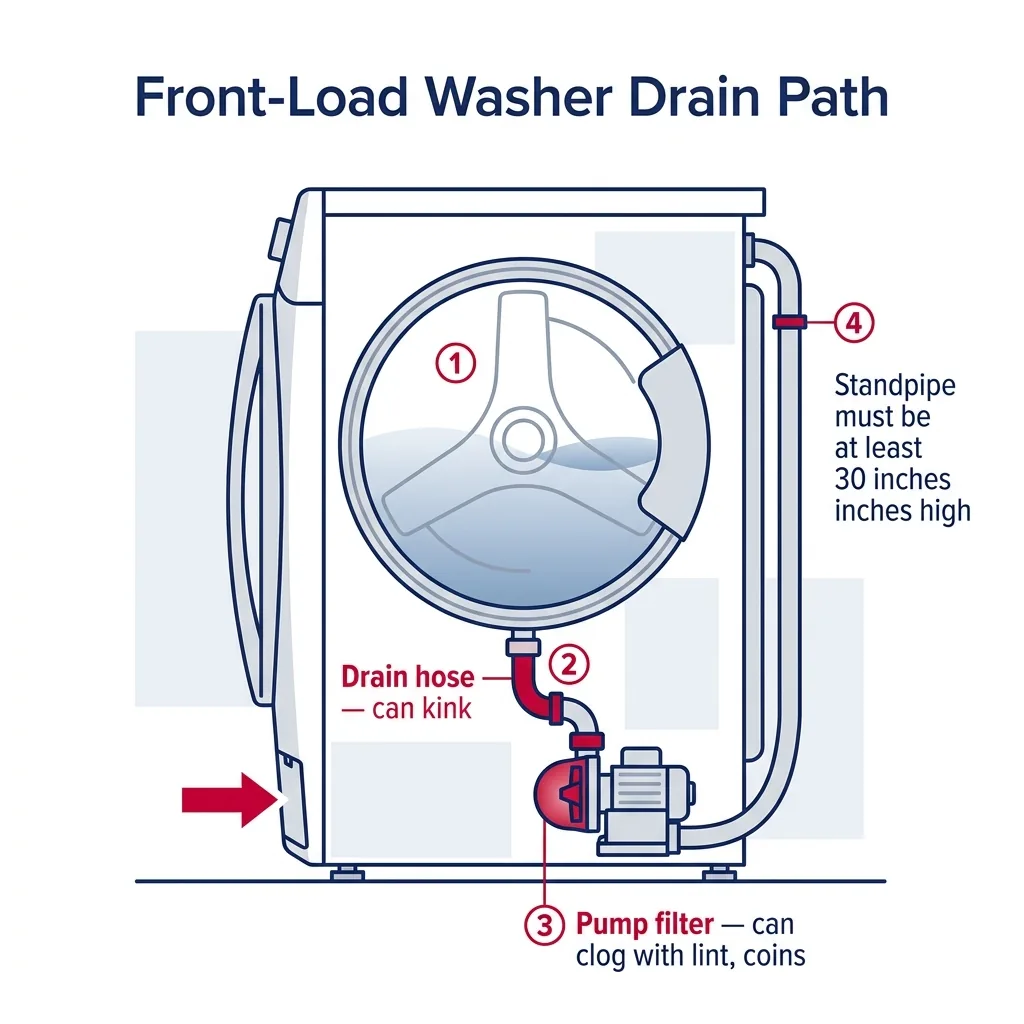
You need an empty tub before starting. On front-loaders, locate the small access door at the bottom-front; it hides the pump filter and a 6-inch black drain tube with a plug. Place a shallow pan down, pull the tube out, and remove the plug to gravity-drain the water in stages. For top-loaders without a filter, use a bucket and sponge or a wet/dry vac. Do not skip this; opening the pump on a full tub will cause a mess.
Tip: On most front-loaders the small drain tube has enough length to reach a low pan but not a tall bucket. A jelly-roll pan or oven tray works perfectly.
⚠ Warning: Place towels in a wide arc around the access door. Even with careful draining, expect 1-2 cups of residual water to escape when you remove the pump filter.
Inspect and clean the pump filter
After draining, rotate the pump filter cap counter-clockwise to remove it. You might need a damp rag for better grip if it is stuck. Pull the filter out and inspect it for lint, coins, hairpins, or other small items. Remove all debris, rinse the filter, and use a flashlight to check the pump cavity. Wear gloves while checking the inside for sharp objects. Replace the filter by hand-tightening it, then give it a final quarter-turn; over-tightening can crack the housing.
Tip: Manufacturers recommend cleaning the pump filter every 1-3 months on heavily used machines. Most homeowners have never done it, which is why the average filter we open contains 2-3 years of accumulated debris.
⚠ Warning: Do not over-tighten the filter, as this can lead to housing cracks.
Check the drain hose for kinks and clogs
Move the washer 12-18 inches from the wall and check the gray corrugated drain hose. Ensure there are no sharp 90-degree kinks, especially where it enters the standpipe or sink. The hose top should be between 34-96 inches high, and it should not be pushed more than 6 inches into the drain pipe. To test, disconnect the lower end, place it in a bucket, and run a Drain cycle. If it flows freely, the blockage is in your home plumbing.
Tip: Ensure the hose isn't pushed too deep into the standpipe to prevent siphoning issues.
⚠ Warning: A standpipe clog will back-siphon the dirty water back into the washer the next time it fills. Clear the standpipe with a hand auger or call a plumber before running another cycle.
Test the drain pump motor
If the filter and hose are clear, the pump motor might be the issue. Unplug the unit, then locate the pump (behind the kick-plate on front-loaders or under the tub on top-loaders). Disconnect the two-wire harness and use a multimeter to check the resistance. A reading of 10-30 ohms is normal; an open reading (OL) indicates a failed winding, requiring a replacement pump ($45-90). Spin the impeller by hand; it should move freely. If it feels locked, debris is likely jammed inside.
Tip: Most modern washer drain pumps are magnetic-coupled, meaning the impeller can be removed and inspected without disturbing the motor seal. Look for a small clip or twist-lock on the impeller housing.
⚠ Warning: Ensure the power is completely disconnected before testing electrical components with a multimeter.
Verify the pressure switch and air dome tube
The pressure switch informs the control board about the water level. If it incorrectly signals that the tub is empty, the washer will skip the drain phase. Find the small plastic tube running from the tub to the pressure switch on the upper rear panel. Disconnect both ends and blow through the tube to ensure it is clear of soap buildup or kinks. If blocked, clean or replace the tube ($10). Use a multimeter to check if the switch changes continuity when you blow into the port. A stuck switch is common on older Whirlpool and GE top-loaders.
Tip: If the tube is full of gunk or soap residue, it can prevent the switch from reading the water level correctly.
⚠ Warning: Handle the pressure switch and its delicate connections with care to avoid damage.
Confirm the lid switch or door lock is signaling correctly
Top-loaders require a closed lid switch to drain, while front-loaders need the door lock to engage. Manually test the lid switch or check the door lock circuit continuity with a multimeter. A failed switch is a $20-35 part and is a common cause for drainage failure. Refer to our spinning guide for more details on testing these switches, as the same component often controls both functions.
Tip: If the washer won't lock, it won't drain. This is a common point of failure.
⚠ Warning: Always confirm the door lock or lid switch circuit is intact before assuming the control board is at fault.
Brand-specific notes
Some brands have known design quirks worth knowing about before you start.
LG
LG front-loaders (WM3500, WM3900, WashTower) display "OE" for drain failures. The pump filter is at the lower-left of the front panel behind a small flip-down door. LG pumps are robust but the impeller housing collects dryer-sheet residue if customers use them — a cleaning every 6 months prevents almost all "OE" errors.
Samsung
Samsung front-loaders (WF45, WF50) often throw "5E" or "SE" drain errors. A common Samsung-specific failure is the small rubber pump-housing gasket cracking and causing the pump to lose prime — water sits in the tub even though the impeller spins. Replace the gasket kit (~$15) when servicing the pump on any Samsung 5+ years old.
Whirlpool / Maytag
Whirlpool Cabrio and Maytag Bravos top-loaders display "F9E1" for drain failures. A frequent cause is the drain hose being installed too tight against the cabinet, partially crushing it. Check that the hose has a gentle bend with no flattened sections before assuming pump failure.
GE
GE front-loaders (GFW450, GFW650) and the older GTW top-loaders use a pump that thermal-trips after running against a clog. Even after you clear the clog, the pump may not run for 15-30 minutes while it cools. Wait, then retest — many "dead pump" diagnoses are actually a cooled-down pump that works fine.
Bosch
Bosch front-loaders (300, 500, 800 series) have a foam-trap built into the pump filter housing that collects detergent foam. If you use too much HE detergent, the trap fills with foam and blocks drain flow even though the filter looks "clean." Run a Drum Clean cycle with no detergent to flush the trap.
What our techs see most often
Across our service area from Seattle to Portland, drainage issues are the most frequent DIY-fixable calls. Customers often find socks or loose change in the filter. If you live in an area with older plumbing, like the historic neighborhoods of Tacoma or Portland, verify that your home's standpipe isn't the actual culprit before replacing parts on the washer.
When to call a professional
- → You've cleared the filter, hose, and standpipe and the pump still does not run
- → The pump motor reads open on a multimeter but you are not comfortable replacing it (involves tipping a heavy washer or working in a tight cabinet)
- → You see water leaking from the bottom of the cabinet during the drain phase — the pump housing or hose connections may be cracked
- → Repeated drain failures despite no visible clog — likely a control board issue requiring board-level diagnosis
- → Your washer is a stacked unit (LG WashTower, Samsung FlexWash) and the dryer must be uninstalled to access the pump
- → A burning smell or melted plastic odor is present — stop using the washer and unplug it immediately
Washer Maintenance & Replacement Tasks
Step-by-step guides for individual maintenance jobs related to this appliance.
Maintaining Your Washing Machine Drain Pump Filter
Removing Mold from Your Front-Load Washer Gasket
How to Descale a Washing Machine with Vinegar (Hard Water Fix)
How to Stabilize Your Washing Machine and Stop Vibration
Replacing a Washing Machine Drive Belt: A DIY Guide
Frequently asked questions
Why is there standing water in my washer after the cycle?
Usually, this is caused by a clogged pump filter (60%), a kinked hose (20%), a faulty pump motor (10%), or other issues like a bad pressure switch or door lock. Always check the filter first; it is the most common and easiest fix.
How do I drain my washer manually?
For front-loaders, use the small black drain tube located behind the front access door. Drain it into a shallow pan in stages. For top-loaders, use a bucket to bail out the water or use a wet/dry vac if the lid is open.
How often should I clean the washer pump filter?
Aim for once a month. If you wash pet bedding, kids' clothing, or items with lots of loose change, you might need to check it more frequently to avoid drainage failures.
Can I run my washer if it is not draining?
Only for testing purposes. Do not run a full load, as it will likely overflow. Always bail the water out first if you need to run a quick Drain or Drain & Spin cycle.
How much does it cost to fix a washer that will not drain?
DIY parts like filters are free to clean, while new pumps range from $45-90, hoses $20-35, and pressure switches $30-60. A-Fix service calls typically range from $150-280 including labor and parts, with the diagnostic fee applied to the final repair.
Need a technician in WA or OR?
If the fix above does not work, A-Fix Service repairs washers across Washington and Oregon. $90 diagnostic visit.
Related Repair Guides
Washing Machine Won't Spin: Troubleshooting Tips
A laundry machine that fills and agitates but fails to reach the spin phase is a common issue for homeowners across the Pacific Northwest, from the humid coast of Bellingham to the dry, cold winters in Bend. Frequently, the issue is as simple as an unbalanced load, a faulty door lock, a snapped belt, or a worn motor coupling—most of which can be resolved in under an hour.
Why Your Washing Machine Shakes and Vibrates: Troubleshooting and Solutions
If your washing machine is rattling the laundry room floor or shifting its position during the spin cycle, it is usually a matter of improper setup or balance rather than a major mechanical failure. The primary culprits—sloped floors, leftover shipping bolts, lopsided loads, and tired shock absorbers—are straightforward to address. Most of these issues can be resolved in under an hour by a handy homeowner.
Maintaining Your Washing Machine Drain Pump Filter
Cleaning the drain pump filter on your front-load washer is a simple but vital maintenance chore. Using a few towels and a shallow container, you can remove trapped debris like coins, lint, and hair to restore proper drainage.